
 English

The Core Contradiction of Package Yarn Dyeing: Where Uniformity Comes From and Where It Is Lost
The goal of package yarn dyeing can be summarized in one sentence: to make the dye liquor reach every fiber surface in the yarn package as consistently as possible. However, the geometric structure of the package itself creates an inherent contradiction: as the dye liquor penetrates from the outer layer to the inner layer, resistance changes, flow rate changes, and dye concentration changes as dye is adsorbed by the fibers. Uniformity is not naturally present; it must be actively “manufactured” by the process.
The first factor determining uniformity is the penetration path of the dye liquor through the package. If the winding density distribution of the yarn package is inconsistent, the dye liquor flows slowly in dense areas and quickly in loose areas, and the dyeing time in different regions will differ. Color difference is often not a problem of the dye itself, but a result of the fluid “traveling different lengths and at different speeds.” Therefore, consistency of winding density is the first physical prerequisite for dyeing uniformity.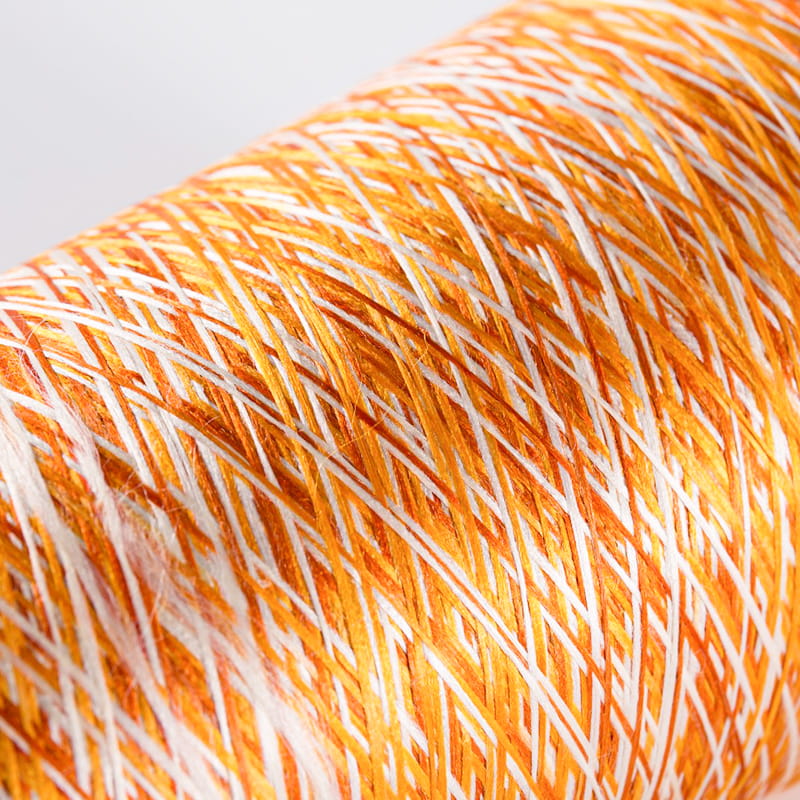
The second factor is the matching of dye uptake rate and dye liquor circulation rate. It takes time for dye to transfer from the dye liquor to the fiber. If the dye uptake rate is too fast relative to the dye liquor circulation rate, dye may be largely adsorbed by the outer fibers before reaching the deep parts of the package, causing a “dark outside, light inside” effect. Controlling the heating rate and adjusting the dye liquor circulation direction—alternating forward and reverse circulation is a common strategy—essentially lengthens the time window for dye to reach all fiber surfaces, allowing the adsorption process to unfold uniformly.
The third factor is microstructural differences among the fibers themselves. Even if the dye liquor distribution is completely uniform, different fibers may still differ in their dye adsorption capacity. Such differences may come from fiber crystallinity, orientation, or surface state, or from inconsistent thermal history in previous processes. The limit of dyeing uniformity is therefore partly determined by fiber structure before dyeing even begins.
Looking at these three factors together, the quality control logic of package yarn dyeing becomes clear: package density determines “whether the path is the same,” circulation and heating determine “whether there is enough time,” and fiber consistency determines “whether fibers at different positions respond to the dye liquor in the same way.” Any deviation in any link will be amplified in the final color difference.
-
Email Us
Wendy@forlandchina.com
-
Find Us
No. 199, Hufa Road, Nanqiao, Fengxian, Shanghai, China
-
Support Center 24/7
Phone: +86-15801865178
WhatsApp: +86-15801865178
-
Copyright © Forland Industrial Co., Ltd. All Rights Reserved.
